

Materials behavior often begins at the atomic scale, making the understanding of how atomic systems behave of vital importance. Atomistic simulation techniques such as molecular dynamics and density functional theory have become instrumental in quantifying how the properties of atomic-level materials systems propagate to larger length and time scales and dictate observed materials behavior. However, our main goal is to link the atomic-scale structure with the underlying materials behavior, and while these simulation methods can provide unparallel insight into the atomic world, characterizing the resulting structure and its evolution is often a bottleneck to providing quantitative insight. This is particularly challenging when the geometric arrangement of atomistic structures exhibits broken symmetry such as those in amorphous and liquid systems. Importantly, the local atomic motifs that primarily exist in these highly disordered systems can show up in many important materials phenomena such as manufacturing/synthesis, radiation damage, and the high velocity impact of projectiles, among others. In this talk I will discuss how our recent work with physics-aware graph neural networks can provide quantitative characterization of the atomic structure under these geometric symmetry-breaking situations and elucidate physical trends that are otherwise unable to be ascertained with existing methods.
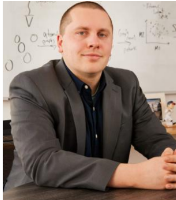
Dr. James Chapman is an Assistant Professor of Mechanical Engineering and is the PI for the Materials Informatics Lab at Boston University. He obtained his PhD in Materials Science and Engineering from the Georgia Institute of Technology in 2020 and completed his postdoctoral work at the Lawrence Livermore National Lab in 2022. During his time at Boston University he has been awarded a Junior Faculty Fellowship from the Hariri Institute for Computing and has received numerous awards for his time as a reviewer for the Institute of Physics journals. His research expertise is on the fusion of data science/machine learning with atomistic/mesoscale simulations to better understand atomic-scale structure-property relationships under extreme conditions. His current work emphasizes graph-based approaches to better connect experimental synthesis and atomistic simulations to design better materials for catalytic, energy harvesting and storage, and structural applications.