

Compositionally complex and high-entropy perovskite oxides provide a unique platform for combining a vast chemical design space with the atomic-scale structural control of epitaxy. A central question is how the chemical disorder intrinsic to high-entropy materials interacts with the structural order imposed by epitaxial strain, interfaces, and nonequilibrium growth. Using B-site high-entropy La(Cr0.2Mn0.2Fe0.2Co0.2Ni0.2)O3 as a model system, we show that nominally equivalent transition-metal cations respond very differently to charge and oxygen chemical potential during PLD growth. Cr preferentially oxidizes and segregates under oxidizing growth conditions, whereas lowering the oxygen chemical potential suppresses this segregation while promoting La and oxygen deficiency, Co/Ni-centered defect formation, and broader multication redox activity. Combined ToF-SIMS depth profiling, atomic-resolution STEM/EDS, spectroscopy, and OER measurements further reveal how cation redistribution and element-specific valence states directly influence catalytic activity, durability, and the accessibility of multication redox pathways. In the complementary A-site high-entropy nickelate (La0.2Pr0.2Nd0.2Sm0.2Eu0.2)NiO3, epitaxial strain drives secondary phase formation, changes Ni valence, and shifts rare-earth 4f-derived states toward the Fermi level, strongly modifying oxygen-evolution activity. These results show that high entropy in epitaxial oxides is not simply about maximizing randomness. Rather, epitaxy and growth chemical potential reshape the high-entropy energy landscape, enabling control of cation distribution, defect localization, metastability, redox flexibility, and ultimately functionality.
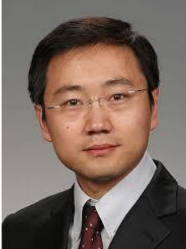
Yingge Du is a chief materials scientist at Pacific Northwest National Laboratory (PNNL), where he leads research on epitaxial oxide thin films, interfaces, and advanced materials synthesis. His work focuses on understanding and controlling materials at the atomic level, including metastable oxides, quantum and electronic materials, high-entropy oxides, and isotopically engineered materials. He has extensive experience in molecular beam epitaxy, pulsed-laser deposition, and surface and interface characterization, and has led multidisciplinary research supported by the U.S. Department of Energy. Du also works closely with university and industry partners to translate fundamental materials science into new capabilities and applications.